
‘Absolute and arbitrary power’: killing Extinction Rebellion and Julian Assange
JVL Introduction
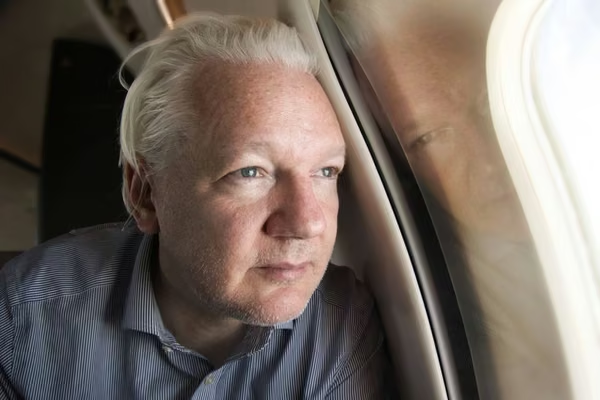
Last week JVL reprinted Jonathan Cook’s denunciation of corporate journalism for its cynical betrayal of Julian Assange, one of a diminishing band of journalists with the courage required to speak truth to power.
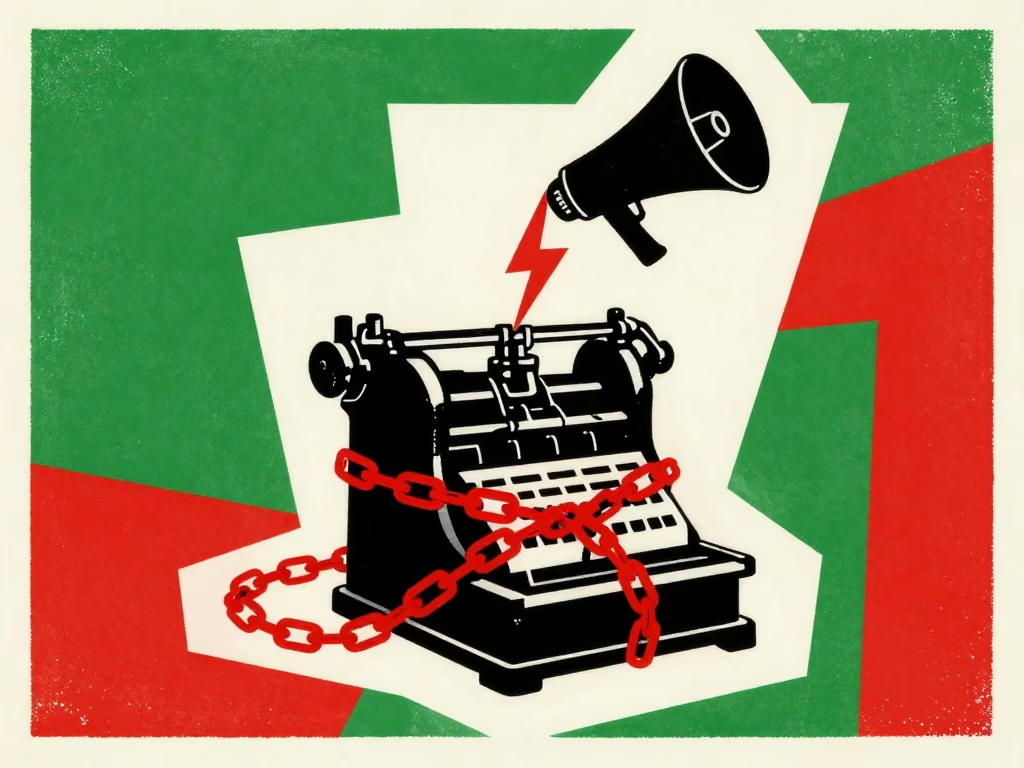
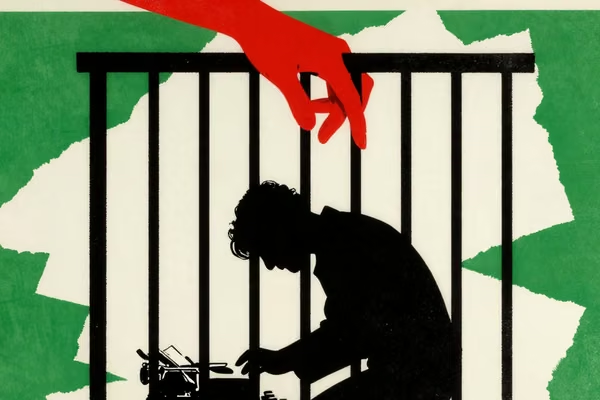
Below we reprint an analysis by Medialens, exposing the hypocrisy of those who denounce XR’s action temporarily disrupting the Murdoch media as an attack on freedom of the press, while remaining silent on a trial which represents the most far reaching global attack on the rights of journalists in history.
When the UN rapporteur on torture, Nils Melzer, last year accused the UK government of the psychological torture of Assange, UK politicians and media haughtily dismissed his opinion. The behaviour of the BBC on that occasion was both typical and telling: they interviewed Melzer and then buried the footage of the interview. Melzer, a distinguished professor of international law, comes across as both honest and extraordinarily convincing. You can watch him speaking about his evaluation of Assange’s treatment here.
Although some of the US liberal media has started very belatedly to become just a little nervous, the celebrity journalists of the UK corporate media have shown little or no interest in reporting on this fundamental attack on freedom of the press, presumably because, as Noam Chomsky long ago pointed out, if they hadn’t internalised the limits of permissible discourse they wouldn’t be sitting where they are.
For a video report last week including an interview with Assange’s legal adviser, see Democracy Now!. Detailed daily coverage of Assange’s ongoing trial can be found here.
GW
This article was originally published by Media Lens on Wed 9 Sep 2020. Read the original here.
‘Absolute and arbitrary power’: killing Extinction Rebellion and Julian Assange
Loading article text…
I listen to Radio 4 a lot. The number of commentators invited to speak on current affairs from small circulation publications like the Spectator and the Economist is truly remarkable. Journalists form the hard right press dominate. BBC impartial?
Thanks goodness for a well reasoned article about the media, away from the hysteria surrounding XR and Assange. The Murdoch empire needs to be dismantled, until they are it is difficult to see how democracy can exist. We seem to be entering a phase reminiscent of Germany in the 1930’s with all the associated perils.
@ Steve. Me too. I notice that R4 news programmes which have a “Labour” spokesperson (mostly only the government side are represented) usually call on ex ministers from Blair’s time.
I don’t suppose that Emily Maitlis (Newsnight) or Jonathan Freedland (Guardian) or Cathy Newman (Channel 4) – or any of the other famous names in British journalism today – have ever heard of Henry Hetherington, much less understood the meaning and value of his great declaration when launching “The Poor Man’s Guardian in 1831. “We will try, step by step, the power of right against might, and we will begin by protecting and upholding this grand bulwark and defence of all our rights – this key to all our liberties – the freedom of the press.”
I was reminded of Hetherington when reading this fine article by Media Lens. I was also stirred to look at the Guardian ‘s on-line media section, something I never normally do. Depending on how you count them, the Guardian had 15 media stories today (16 September). These stories about things like Fox News broadcasts in America or Gary Lineker’s pay were so important to “this grand bulwark of all our rights” that they crowded out any mention of the fact that Julian Assange was fighting for his personal liberty and the liberty of the press in the Old Bailey, just down the road from the Guardian’s office.
If the “freedom of the press” is to mean anything – if it is truly to be a bulwark of all our rights – then journalists in Britain should be vociferous in their defence of someone like Assange. Instead, the great and the good of British journalism remain craven and silent. By their silence they are complicit in the relentless attacks on all our liberties. They are not remotely trying the power of right against might: they are defending a corrupt and cruel imitation of democracy.
NB Henry Hetherington was jailed. We may be sure that none of the journalists who remain silent on Assange today will ever share his fate – or his moral courage.
Three hours after you published my comment about the craven silence of British journalists on the threat to freedom of the press posed by the extradition proceedings against Julian Assange (16 September) something remarkable happened: the Guardian broke its long silence and published an online report (at 00.37 on the morning of 17 September) about Daniel Ellsberg’s evidence to the judicial charade being played out at the Old Bailey the previous day. The fact that the Guardian had to rely on Reuters for its copy, suggests that senior editorial staff did not regard the court hearings as sufficiently important to merit one of its own reporters attending.
Even more extraordinary, the Guardian today (18 September) published online a court report by Peter Beaumont about an American government offer to “pardon” Assange for publishing the Wikileaks documents (in the Guardian, New York Times and the Washington Post) if only he would reveal his source. Beaumont’s story was certainly newsworthy, and it contained a link to the Ellsberg evidence the previous day. There was a second link – to a story published by the Guardian on 14 June about the American military killing of Reuters’ journalists in Bagdad – and that, turn, contained a link to a story by Roy Greenslade dated 2 February which carried the headline “Press freedom at risk if we allow Julian Assange’s extradition.” On-line readers of the Guardian have therefore been given four stories about Assange and the extradition case in the space of 48 hours.
Of course, the Guardian has also published numerous vile personal attacks on Assange in recent years, presumably to make sure that their readers fully understand why he doesn’t deserve to be protected by the British judiciary – but let us be thankful that there seems to be at least one journalist on the paper who understands the struggle being waged at the Central Criminal Court and why it is relevant to freedom of expression.