
A view from France’s mass demonstrations
JVL Introduction
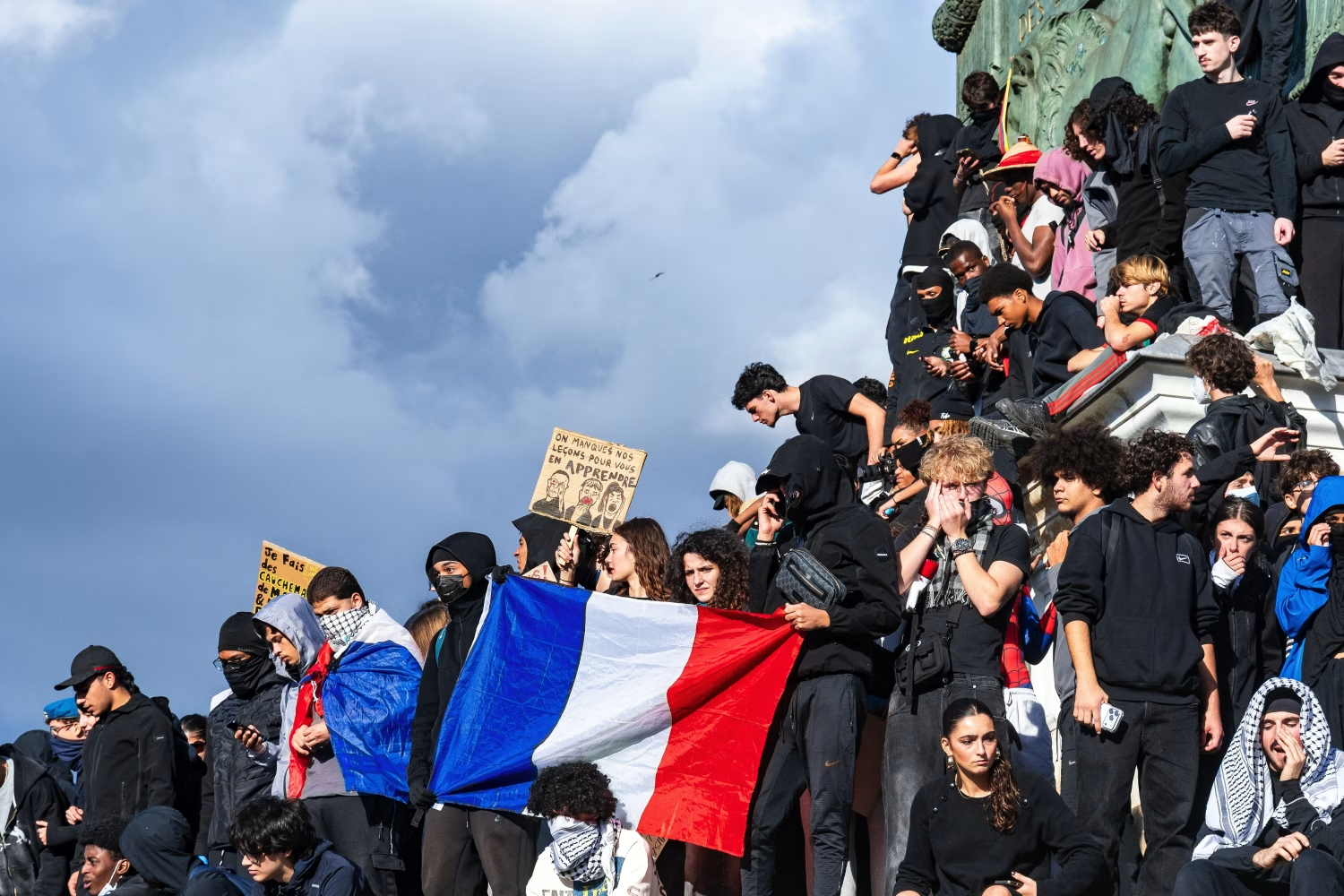
Members of one of JVL’s sister organisations, UJFP (French Jewish Union for Peace) were involved in demonstrating for change, better public services and against neo liberalism at the weekend. This is a personal reflection and summary by one of UJFP’s leading members. He does not skirt over the reality of the violence and looting by some participants known as “Le Bloc Noir” (Black Block) but he also stresses the underlying and long standing causes that led to the demonstrations and the violent response of the police, which started from the first peaceful walk outs by french high school students who were then often protected by parents, teachers, other workers from the brutality with which they were met. The commitment to heavy handed policing was made clear by french political leaders and seems to have been the major factor in the escalation of tension and violence.
Through social media, many of us will also have seen the demonstrators in many cities singing and dancing, filled with joy. You may have seen the applause for the police who removed their helmets showing that they were not going to, eg use water cannon or stun grenades; there was also the 100 strong ‘Orchestra of the New World’ in central Paris forced to flee through tear gas. This is not being reported in the UK’s mainstream media. Nor is there much about the underlying reasons for the massive response to the call to demonstrate. Another call has gone out for 5th November, possibly calling for a general strike.
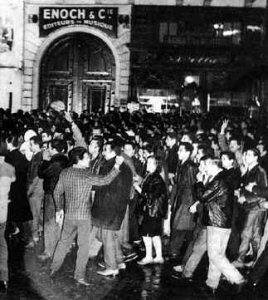
History is also important and we may well remember a long history of massive demonstrations in France: Richard Wagner starts his article by recalling that the 17th October is also the anniversary of the terrible massacre of c 100 Algerians in the heart of Paris in 1961 when Algerians in France demonstrated in support of the struggle for independence. Some of the signs I saw read “We are the descendents of the Algerians you did not drown”. (nous sommes les descendants des algériens que vous n’avez pas noyés). That demonstration in 2961 also started peacefully.
LL
On 17 October 2026, hundreds of thousands of demonstrators took to the streets throughout France: in the big cities, the smaller towns and even in the countryside.
In fact another major event took place in recent French history on 17 October. It occurred in 1961 in the middle of the Algerian independence war. The French police killed over 200 Algerians in Paris and threw most of the corpses in the Seine River. Since then, French anticolonialist activists commemorate this state crime every year on 17 October with a rally on a bridge over the Seine in downtown Paris.
I’m sure that 17 October 2026 will henceforth be commemorated as the anniversary of one of the most massive protests that shook the country since the student revolt and general strike of May 1968.
To paraphrase Marx, a spectre is haunting France: the spectre of the Yellow Jacket movement. This popular uprising against the high cost of living arose in 2018 when motorists put on their yellow reflector jackets and occupied traffic circles, especially in semi-urban and rural regions where public transport is insufficient, often totally absent. Workers in these localities have to use their cars to get to their jobs. The high price of fuel (largely due to taxes) was the spark that set off a mass movement. It came from the victims of President Macron’s neo-liberal policies, and many of those who occupied traffic circles with their yellow jackets were first-time demonstrators.
This year it’s another sector of the population which sparked the current uprising: the youth. Protests started in high schools and junior high schools, many of which require urgent repairs, especially in the context of climate change (classrooms are freezing cold in the winter and sweltering hot in the spring, the beginning of summer and the back-to-school season in September). Not to mention the lack of substitute teachers. Students in junior high schools and most students in high schools are too young to vote. Those in the last year of high school who just turned 18 aren’t the most assiduous voters on election day. So the government tends to ignore them.
French teachers in the public sector are among the lowest paid of their profession in Europe and public schools have a hard time attracting new recruits. Barely two weeks after classes resumed on September 1st the first student walkouts started in the working class suburbs of Paris and rapidly spread throughout the country. The barricades they erected in front of their schools and the demonstrations they organized in the streets were reinforced by the presence of their parents, concerned about their kids’ future. A good number of these parents suffer from low wages and the same neo-liberal austerity as their children. Along with this parental reinforcement came the participation of teachers and their unions, who have the same demands concerning the repairs of public schools and the hiring of more teaching staff. Then came university students in solidarity with their younger bothers and sisters in high school, trade-unionists in different sectors of the economy who are revolted by low wages which don’t catch up to inflation. The considerable rise in fuel prices due to the blockage of the Hormuz Strait (thanks to the war started by Trump and Netanyahu) quickly mobilized other sectors: taxi drivers, truckers hauling merchandise on the highways, fishermen confronted with fuel prices for their boats, farmers who can no longer afford to fill the tanks of their tractors and nurses who have to choose between filling their fridges at home and filling the tanks of their cars to service their elderly patients for home visits. Then hospital staff joined the protests, demanding better public funding for a severely degraded public hospital system. Other workers from different sectors – both public and private – joined the ranks of demonstrators.
Then the Yellow Jackets came out of the woodwork like a resurrection. This movement shook the country eight years ago. With a massive mobilization throughout France, Macron was obliged to throw in the towel in 2020 and announced a number of concessions to the working class. He ended tax increases on fuel, indexed old age pensions to inflation, lowered income taxes for the “middle class” (most workers) and increased the minimum wage. Only struggle pays! When the historic leaders of the 2018 Yellow Jacket movement came out to support the high school students and accompanied them in the streets, the political elite trembled. The entire spectrum of left-wing political leaders and the members of their parties joined the demonstrations on 17 October, from the revolutionary far left to La France Insoumise (radical left), the Communist Party and the Ecologists.
French presidential elections will take place in April-May 2027 and the leadership of all political parties are now obliged to take a public stand on the demands expressed by the demonstrators. The entire left (including the helplessly moderate “Socialist” Party) has expressed its support for demands in favour of youth and workers, both those currently on the job and those who survive on modest retirement pensions. The right-wing parties pay lip service to some of the concerns raised by demonstrators, while severely denouncing the “violence” which took place on the occasion of a number of marches, but not the violence committed by the police. As for the far right (Le Pen’s Rassemblement National which hopes to accede to power in 2027) it doesn’t talk about the protesters’ demands. It only denounces the “violence” (of the demonstrators) and loudly stresses its total support… of the police.
At the end of the day on 17 October, the minister of the Interior announced no less than 110,000 demonstrators in Paris alone. After arresting more than 6,000 students over the past two weeks, the police made 2,300 arrests throughout France on 17 October, including 1,800 arrests in the city of Paris alone. There were over 10,000 injuries nation wide on both sides (demonstrators and police).
We assembled in the capital’s emblematic Place de la République for a march that was officially authorized. And yet the police prevented people from leaving the square, soon filled with tens of thousands of demonstrators. They pushed back contingents of marchers who managed to break through police lines and take to the streets. Police forces didn’t hesitate to use their favourite method: repression. Tear gas, deafening grenades, police charges and nightsticks fell upon numerous marchers, including teenagers from the high schools. So instead of one single, disciplined march from one point to another (originally approved by the authorities), the movement metamorphosed into a multitude of unauthorized marches in numerous streets and neighbourhoods, each of which included several thousand demonstrators.
Unfortunately, the “Black Blocks” proved to be just as violent as the police. From the beginning at the Place de la République, these youngsters dressed in black, faces masked, armed with sticks, bats, crossbars and bricks attacked both the police and store windows. They set fire to a number of cars, smashed windows and looted shops, thus destroying the jobs of those who work there. By the evening a number of neighbourhoods looked like battlefields and residents were understandably devastated by the extent of the destructions. The “Black Block” phenomenon has been around for years but is a growing threat to demonstrators and residents alike. It tends to keep people away from marches instead of encouraging them to participate. On the 17 October evening news, most TV channels reported more on the destructions than they did on the demands of the demonstrators. A handful of “Black Block” activists anonymously testified, saying that it’s the only way to force the government to listen to the people’s legitimate demands. But most “Black Block” participants appear to be unpoliticized youth from poor neighbourhoods who just want to settle accounts with the police, enjoy an adrenalin shoot and loot luxury stops. It’s part of a global problem in the rise of poverty and it’s certainly no solution. But it’s symptomatic of increasingly precarious living conditions for many layers of the working class.
Clashes between demonstrators and police were far from being limited to Paris. Violence broke out in numerous cities, including Rennes, Nantes, Bordeaux, Limoges, Bescançon, Lyon, Marseille and Toulouse. In Limoges (a city of 140,000 inhabitants) the city hall was burned to the ground. Only the façade remains standing after one of the Black Blocks threw a torch into this building, erected in 1833 and classified as a historical monument. In Marseille, no less than 30,000 looters were reported. These youngsters – mainly from the poor neighbourhoods – were not the ones who broke the shop windows. They only took advantage of the situation to grab what they could before running home.
It’s not only the spectre of Yellow Jacket activists, of the youth and of the workers’ movement which is haunting France. It is especially the spectre of a mass movement with the potential of becoming permanent which is now haunting the nights of the ruling class.
The day after 17 October President Emmanuel Macron appeared on national television in a solemn address to the nation. He commented the events of 17 October, denounced the “looters”, deplored the destructions, supported the police and didn’t announce a single measure to improve conditions in the school system, the public hospitals or elsewhere. He refuses to tax capital gains as much as he taxes labour and he equally refuses to raise individual income tax for the ultra-rich.
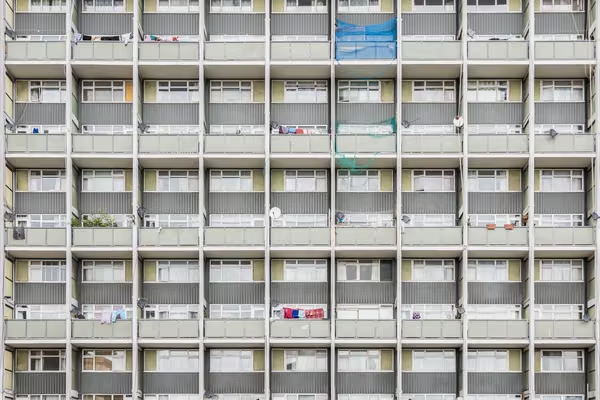
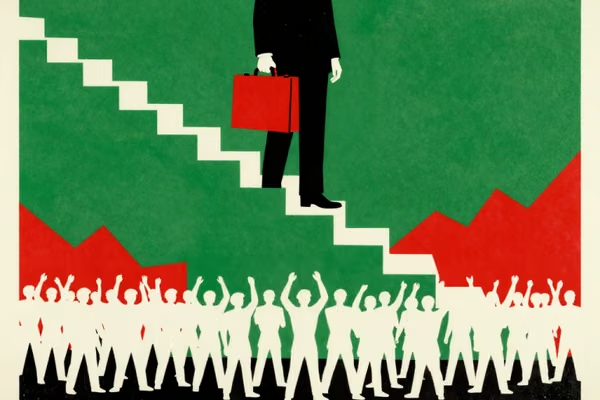
The context of this revolt comes in the wake of increasing economic disparities between the social classes. There are over 13,000 millionaires in France that don’t pay income tax (they hide their fortune in bank accounts domiciled in offshore tax havens). The profits of the 40 biggest French companies have literally exploded over the last 20 years. There are now over 40 billionnaires in France, while a good number of workers who have stable jobs line up in front of soup kitchens to put enough food on the table for their families. Numerous residents fear being expelled from their apartments because they got behind in paying the rent. The only thing that has been constantly increasing (aside from inflation) is the gap between the very rich – not even 1% of the population – and the rest of the country. Despite dire needs to revamp essential services, the Prime Minister is now preparing a budget with a reduction of 54 billion euros (85 billion Canadian dollars) in public spending. This is intolerable for most people and the protests in their multiple forms are not likely to disappear overnight.

No comments on this post so far.