
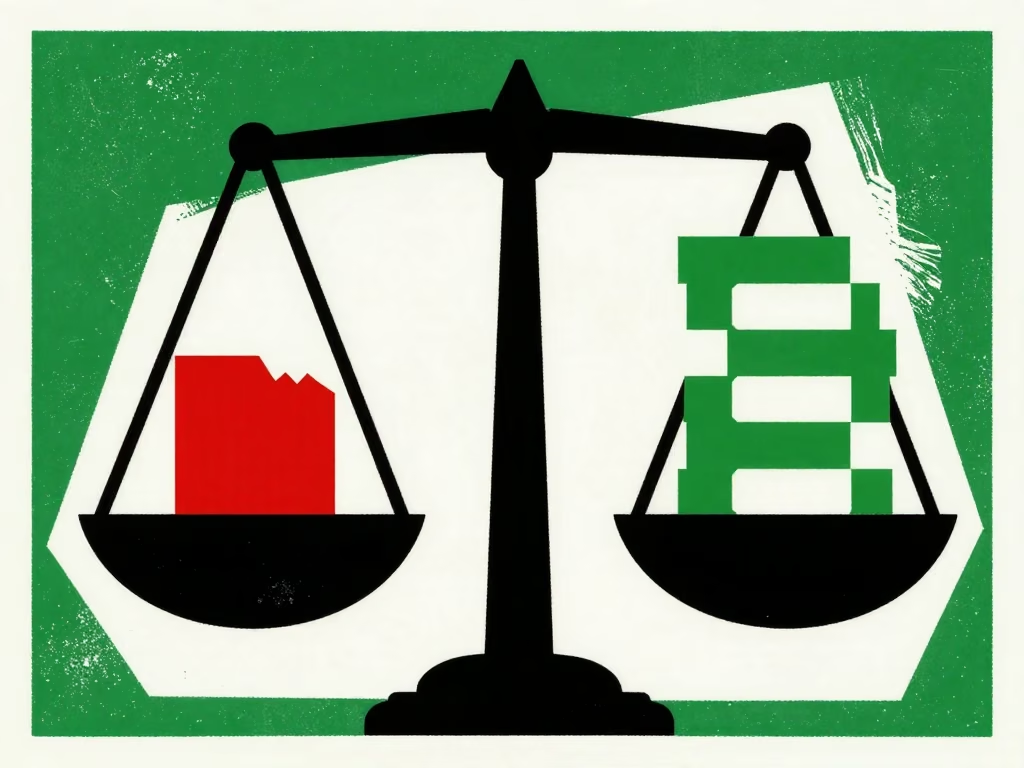
There is an alternative – tax wealth
JVL Introduction
The scale of the coming catastrophe we face is perhaps not well enough understood. We hope the items reproduced here will remind us all of what is in store in the coming months from yet another self-seeking, class-war waging Tory government; what the alternative might look like; and the complete failure of Starmer’s Labour to offer any serious alternative.
Adam Ramsay recalls austerity last time round, in response to an economic crisis with global dimensions. It didn’t work then and it won’t work now.
Owen Jones tears into the BBC for its normalisation of the cuts we are about to receive, saying: “In its coverage of Rishi Sunak’s ascent to the premiership, the BBC declared that spending cuts – as well as tax rises – are inevitable.” They are not. They are both are political choices.
And as Jones notes, the Tax Justice Network and the UK Wealth Tax Commission have shown that relatively modest taxes could easily cover the c.£40bn deficit, and a modest wealth tax raise £260bn over five years.
Rupert Neate’s article, reposted below, provides backup to these figures.
So there clearly is an alternative. But Labour, when so much is needed, is offering so little, apart from a sensible but inadequate investment in renewables.
Why? Perhaps because any sensible alternative will have to draw on so much of what the 2017 and 2019 manifestos were offering…
No one voted for Rishi Sunak to return the UK to crippling austerity
OPINION: Sunak wants yet another round of cuts to public spending. And just like in 2010, we didn’t vote for it
Adam Ramsay, openDemocracy, 24 October 2022
When Rishi Sunak resigned as Boris Johnson’s chancellor in July, Westminster lobbyists whispered that the real reason was a disagreement about austerity ahead of a looming speech on the economy.
Johnson, so the rumour went, was against austerity and keen to stick to the agenda set by his 2019 manifesto. Sunak, it was said, wanted to be, as he saw it, “more realistic”.
In his resignation letter, Sunak alluded to this difference of opinion, talking about private disagreements and the need to “make sacrifices and take difficult decisions” in order to achieve a “low tax, high growth economy”.
In the race to replace Johnson as Tory leader and prime minister, Sunak denounced his opponent Liz Truss’s plans – not because she wanted to slash tax rates for the rich, but because doing so would involve borrowing, which, he argued, would boost inflation.
“My strong point of view is, if the government goes on a huge borrowing spree, that is only going to make that situation worse. And that will mean that the problem will last longer,” he told radio station LBC.
But the Tory membership baulked at Sunak’s economically hard-Right agenda, and voted for insanity with Truss instead. At this point, the markets weighed in. Truss didn’t have any credible plan to get the UK economy back on track. And as we’ve all seen, in our era of globalised capitalism, financial markets still have real muscle.
This time around, following Truss’s humiliating departure after six weeks in office, Sunak’s campaign website didn’t explicitly mention austerity. But the first point in his ten-point plan is “A long-term plan to beat inflation.”
This suggests that with Sunak set to become prime minister, the UK is headed for another round of devastating cuts to our public services – cuts that we did not vote for.
Instead, in the 2019 election, the Tories ran on a manifesto that promised significant spending increases across a slew of public services, and a bid to ‘level up’ the country. If they had tried to argue for swingeing spending reductions, they would have lost.
2010: Austerity part 1
These cuts will come on the back of another brutal round of austerity – which the UK also didn’t vote for. Before the 2010 general election, Labour, the SNP and the Greens all proposed investing to boost the economy after the 2008 financial crash. The Lib Dems promised not to cut spending within the first year after the election, waiting until, they hoped, things had got better. Between them, these parties won 54.7% of the vote and a majority of MPs.
It was only because the Lib Dems ditched their promise – signing up to a coalition agreement with the Tories that included taking the axe to public services immediately – that the austerity programme masterminded by then-chancellor George Osborne went ahead.
At the time, most serious economists called out Osborne’s agenda as the nonsense it was. A basic understanding of economic history showed that cutting public spending in a recession just takes money out of the economy, driving down spending and wages, and prolonging the slump.
Austerity drove millions of people into poverty. Homelessness soared, and the NHS was damaged
Again and again, Osborne trotted out one particular academic paper to justify his assault on the welfare state – a 2010 study by Carmen Reinhart and Kenneth Rogoff, which compared GDP growth rates in various countries against their public debt and seemed to show that higher debt slowed growth.
But in 2013, that paper fell apart. A postgraduate economics student in the US looked through their spreadsheet and discovered they had made some serious copy/paste errors. Fix the typos, and their findings – the only justification for austerity – disappeared.
In reality, the cuts did what most economists said they would: they prolonged the recession, drove down wages and did a decade of damage to the UK economy. With tax receipts failing to rise – which is what happens when wages fail to rise – government debt ballooned as a percentage of GDP.
Millions of people were driven into poverty. Homelessness soared, and the NHS was damaged. A decade in which serious investment was needed to switch the UK to a zero-carbon economy was wasted.
But its advocates didn’t mind, because austerity was never actually about a desire to cut government debt. It was always about an ideological obsession with slashing the public sector and letting capitalism run free. The point was to allocate as much as possible of society’s wealth through the market – one pound, one vote – rather than democratically – one person, one vote.
This time, that’s clearer than ever.
Alternatives to austerity
Across the Western world, other governments are choosing a different path out of the pandemic.
Under its post-Covid “recovery plan for Europe”, the EU has issued its first-ever bonds to deliver more than two trillion euros of investment in infrastructure across the bloc. This is the continent’s largest-ever stimulus package, which is particularly focused on the low-carbon infrastructure needed to lessen the climate crisis.
In the US, Joe Biden is doing the same with his Inflation Reduction Act, which will inject hundreds of billions of dollars into cleaning up the US economy, reducing price hikes by trying to wean the country off fossil fuels.
It’s true that, unlike in 2010, borrowing now is more expensive. Back then, interest rates were so low, money was almost free, making Osborne’s vandalism pointless. But now, the cost of not borrowing is even greater – because the threat of a slump is bigger, the climate crisis is even more urgent, and our public services and infrastructure are at greater risk of collapse.
Despite this, Sunak seems to be planning to slash and burn the UK economy, directly against the wishes and express promises of his party to Britain’s voters.
And there is little sign that Keir Starmer’s Labour Party will oppose him, which means the rest of us will have to.
Don’t let the BBC get away with it
Owen Jones, 25 Oct 2022
This is an unacceptable breach of journalistic objectivity – with potentially devastating consequences. In its coverage of Rishi Sunak’s ascent to the premiership, the BBC declared that spending cuts – as well as tax rises – are inevitable. Both are political choices. If the government decided to increase taxes on the wealthy – as I set out here – then they could avoid spending cuts.
If the BBC get away with this, they’ll keep doing it – and soften up public opinion to protect the government from anger at unpopular cuts, because the electorate will decide they’re inevitable.
Please complain to the BBC here – making it clear you’re complaining about Nick Eardley’s comments at 10:16 on the news channel – “The economic backdrop has changed: Mr Sunak is going to have to agree to spending cuts, and to tax rises” – which presented austerity as inevitable, rather than a political choice. Make a complaint.
Please share, press like, subscribe – and help us take on the right-wing media here: https://patreon.com/owenjones84
And here is a short article in the Guardian elaborating the tax possibilities that Owen Jones refers to:
Tax Justice UK calls on Rishi Sunak’s government to introduce five reforms targeting the richest people
Rupert Neate, Wealth correspondent, the Guardian, 25/26 October 2022
Rishi Sunak’s new government could raise up to £37bn to help pay for public services and the energy bills support scheme if it introduced a string of “wealth taxes”, according to tax equality campaigners.
Tax Justice UK called on the government to introduce five tax reforms targeting the very wealthy, who the campaign group said had done “really well financially” during the coronavirus crisis and national lockdowns, rather than seek to save money with further cuts to public services.
“Tax is about political choices. At a time when most people are being hit hard by the cost of living crisis it would be wrong to cut public services further,” said Tom Peters, Tax Justice UK’s head of advocacy. “The wealthy have done really well financially in the last few years. The chancellor should protect public spending by taxing wealth properly.”
The campaign group, which is calling for a “fairer tax system that actively redistributes wealth to tackle inequality”, suggests five “wealth tax reforms” that it said could bring in an additional £37bn in tax income. It said:
- Equalising capital gains tax with income tax could raise up to £14bn a year. At present many well-paid people who earn an income from their investments such as stocks and shares can pay capital gains tax at a rate of 20% rather than income tax, which is as high as 45% for earnings over £150,000. CGT also applies to income from selling a second home or stocks and shares.
The campaigners said this would simplify the tax system and “treat all forms of income in the same way”. “There is no obvious reason why someone going to work should pay more tax on their wages than someone selling their second home, for example.”
- Applying national insurance to investment income could raise £8.6bn.
- Closing loopholes on inheritance tax could raise £1.4bn.
- Scrapping the non-dom regime and taxing their offshore income could generate £3.2bn.
- And introducing a 1% tax on super-rich people’s assets over £10m could raise an additional £10bn.
Tax Justice UK said “a small wealth tax applied to those at the very top” could raise nearly £10bn and would “help to rectify some of the issues with our existing wealth taxes, which are often avoided by the very richest”.
The UK Wealth Tax Commission last year recommended that a one-off 1% wealth tax on households with more than £1m, perhaps payable in instalments over five years, would generate £260bn – more than enough to cover a year’s funding of the NHS and social care spending.
Arun Advani, an assistant professor at the University of Warwick’s economics department and a member of the Wealth Tax Commission, said: “We think there are 22,000 people with wealth above £10m in the UK. So you might want to start with them or even further up. If you started there, it would only be the top 0.05% of the population.”
 You can download the 2020 report of the UK Wealth Tax Commission here.


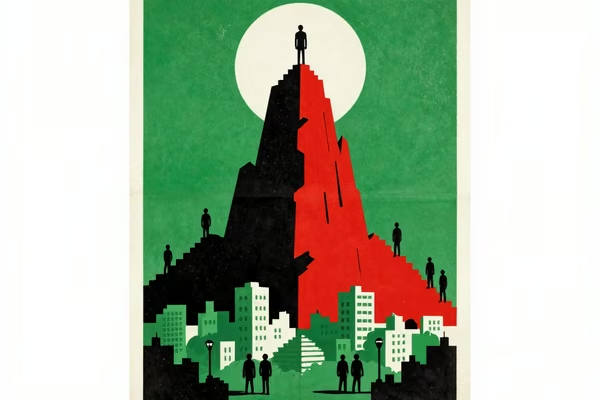

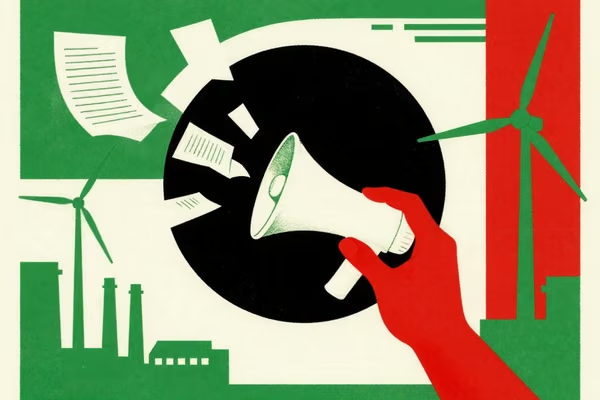

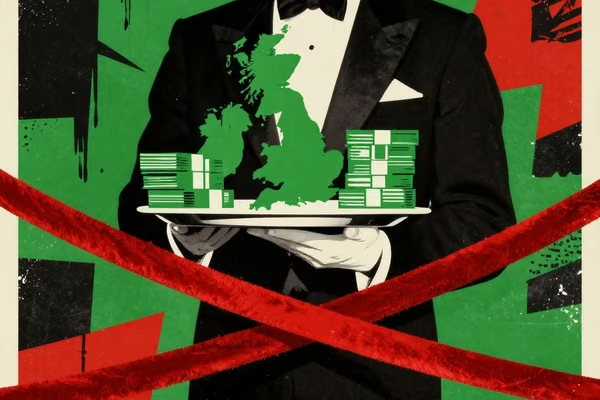
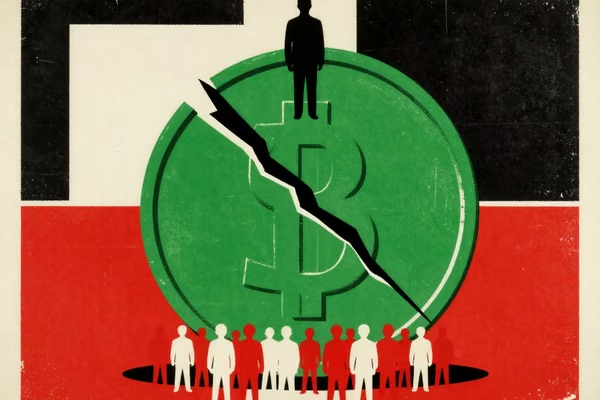





The extraordinary wealth flowing through the city of London and New York wasn’t just stolen from the British and US proletariat. It is the proceeds of a world-wide smash and grab raid of which the people of the global south are the foremost victims. Every 26 hours since the Covid pandemic struck, another billionaire is created whilst at the same time millions more are impoverished worldwide.
This dossier from the Tricontinental Institute explains that case in more detail.
https://thetricontinental.org/newsletterissue/geopolitics-of-inequality/
1% of the value of an average house in the South East … is quite a lot for most people to find.
Btw .. Not comfortable with any publicity for Owen Jones
I agree with Les Hartop about Owen Jones, who, in similar fashion to George Monbiot, likes to gesture from his comfortable mainstream niche.
Jones also confuses his lexical semantics a bit. The cuts ARE ‘inevitable’ BECAUSE they are a ‘political’ choice.