
Small Acts: Protesting Against Genocide with Defend Our Juries
JVL Introduction
In this account of a Defend Our Juries action on July 30th 2026, Tony Booth describes the background to their decision to escalate protest following the decision of the Court of Appeal to overturn the High Court Decision that the proscription of Palestine Action by the UK government was unlawful. He suggests that the police may have deliberately created chaos on the day and even maximised the number of arrests, for example, arresting several people who had just come along to observe what was happening. The subsequent claim by the Metropolitan Police that protesters were deliberately diverting police resources from serious crime only reinforced the conclusion that the Police knew they were not arresting anyone who had an interest in carrying out terrorist acts.
Tony Booth’s article is also a personal account of why he took the action and his own experience on the day. He describes his equivocation over whether to risk being arrested. On balance he sees his own small action on the day as contributing to “a bigger push to resist the suppression of protest against genocide in Palestine”.
Defend Our Juries are continuing the campaign to end the ban on Palestine Action, taking it next to the Labour Party Conference in Liverpool on September 27th 2026. You can find more information about that action here.
TB
Introduction
I am witnessing genocide in Palestine, accelerating in the last three years, and feel powerless to act. This source of impotence adds to my feelings about halting global environmental collapse and the faux privatisation of the education system, which took up decades of my employed life.
I go on protests, get myself arrested, as I have also done to defend nature; I comment on social media, sing for Palestine and Palestinians, offer some funds. It makes me feel a little better. Doing almost nothing is better than doing nothing, and I know that our collective action is felt as supportive in Gaza and the West Bank and it keeps up each other’s spirits. I admire those who do so much more than me, taking greater risks with their bodies, working alongside Palestinians or others facing military or environmental annihilation, or give up much more of their privileged lives than I do.
As part of my small contribution, I have joined gatherings organised by Defend Our Juries (DOJ) to protect the rights of juries, rights to protest and to overturn the proscription of Palestine Action. This was amongst the maddest changes in the law I have witnessed in my lifetime. I do not think that Palestine Action is perfectly organised. I think there is too little care over who is encouraged to engage in arrestable direct action, foreign nationals, for example, in danger of deportation. They should also have had more effective non-violence preparation before actions. But I admire the courage and achievements of those who risk imprisonment to interrupt the supply of weapons to a genocide. In this account I describe my involvement in one action with DOJ on the 30th July 2026. It was planned after the judgement of five judges at the Court of Appeal.
The Court of Appeal confirms that the Palestine Action ban is lawful.
On the 15th June 2026 five judges at the Court of Appeal released their unanimous judgement that reversed the High Court’s decision on 13th February earlier in the year which had ruled that the government’s proscription of Palestine Action as a terrorist organisation was unlawful. The new judgement was relayed by loudspeaker to a crowd of about 200 of us outside the court. We were stunned, upset. People cried. It was jaw dropping in its seeming bias. Its most obvious errors were quickly picked up by the mainstream press who found it a mystery that five judges could collude in misrepresenting the suffragettes as non-violent and transparent, so that the judges could contrast their fine example of direct action with what were claimed as the violent, secretive terrorists of Palestine Action.
Less noticed was the way the judgement followed rogue trends in the courts which prevented activists from explaining their motivation. The judgement paid little attention to the fact that Palestine Action was attempting to interrupt a genocide. So, this lent negligible weight to arguments that the effects of the ban on freedom of expression were disproportionate. The court also misrepresented the proscription process in Parliament as, surprisingly, Liberty has done too. The judgement attributed it solely to the actions of Yvette Cooper rather than MPs voting on a proscription order she brought to Parliament carefully packaged to secure the vote .
MPs had been gullibly persuaded to support a ban, because proscription of Palestine Action was bundled together with the Maniacs Murder Cult and the Russian Imperial Movement, two avowedly racist violent groups with no known activity in the UK. I have now asked around 20 police officers, at protests, if they have arrested anyone supporting these groups. I haven’t yet met a member of the police who has heard of either of them. I point out that it is unlikely they would be arresting those expressing support for Palestine Action had it not been for the inclusion of these groups in the proscription order passed by Parliament. The story of how these particular groups entered the equation when they were not known in the UK, remains opaque – but is likely to have involved intelligence services of the UK, the US and perhaps Israel working together. We know the extent to which Elbit systems, Israel’s largest arms manufacturer was lobbying the government to ban Palestine Action.
I suspect, too, that the proscription of Palestine Action might not have happened if the group had not daubed a putting green on Donald Trump’s Turnberry golf course with the words: Gaza Is Not 4 Sale. When he heard from Keir Starmer that the perpetrators were involved in Palestine Action and had been apprehended, he labelled them “terrorists” and called for them to be “treated harshly”. So, the standard narrative of the banning of Palestine Action as being carried out by Yvette Cooper, following the spraying of warplanes with red paint, provides an inadequate account. In August 2026 the Trump administration finally designated Palestine Action a terrorist group, as part of its attack on organisations and people supporting justice for Palestinians and threatened to impound any assets held in the US. It said that the group has been involved in “numerous acts of terrorism since July 2020”.
Defend Our Juries ramps up resistance to the ban.
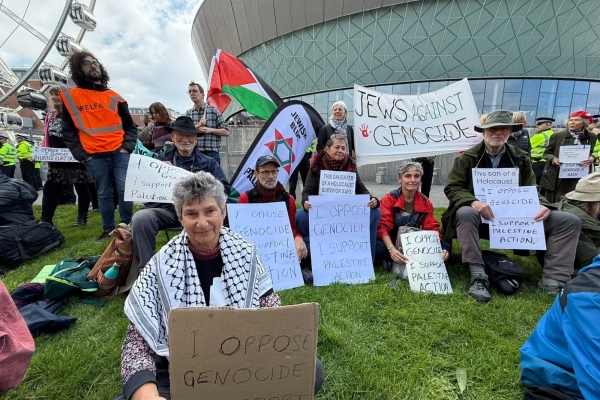
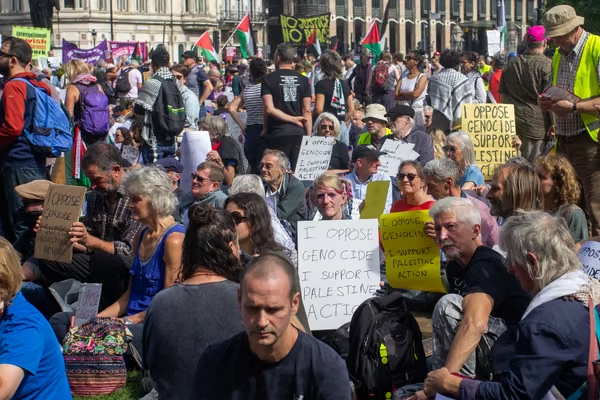
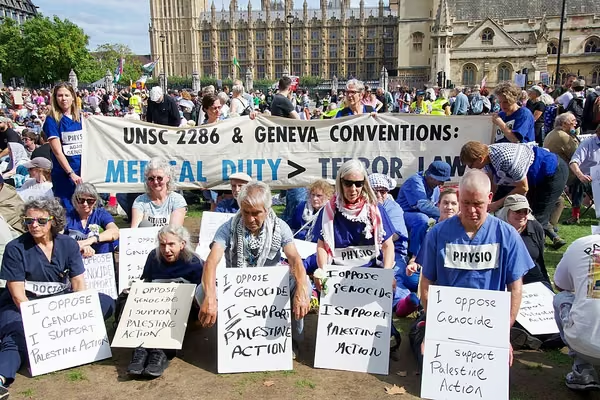
After the Appeal Court judgement, I was readily convinced by the determination of Defend Our Juries to continue to campaign to overturn this most ludicrous of bans and defend the right to protest against genocide. I had been arrested three times, previously, for holding a placard stating: “I oppose genocide; I support Palestine Action.” These arrests alleged an offence under section 13 of the Terrorism Act 2000, for carrying “an article in such a way as to arouse reasonable suspicion that [I am] a member or supporter of a proscribed organisation”.
The action planned for July 30th was intended to escalate the offences to section 11 of the Terrorism Act 2000, for being a member of a banned organisation and section 12, for encouraging others to support or join a proscribed group. Section 11 and 12 carry a maximum sentence of 14 years. They also require a jury trial, also under threat since David Lammy announced the wish of the then Labour administration to end them for all trials carrying a maximum sentence of less than 3 years.
I consider arrest.
On July 29th, I read the action briefing notes and was deterred from acting in a way likely to provoke arrest. The briefing emphasised the possibility of a prison sentence. I hate the thought of going to prison for any length of time, even though good friends, more courageous than I, have done so for climate protest. I have always calculated that my arrests are unlikely to lead to a prison sentence but felt more worried about that on this occasion. I also reckoned that it was highly likely that I would be kept overnight in a police cell which would mean missing a dinner with friends that had been arranged some time previously. I decided that I would go as a supporter of those being arrested and maybe join with others singing encouragement. I would take my phone and photograph the occasion.
There were other reasons for my reluctance to join arrestable acts. The day had been dubbed “graduation day” for those who had been arrested previously for supporting Palestine Action. I was not keen on this designation, seeing it as detracting from the seriousness of genocide. I was also not drawn to uttering the exact words asked of potential arrestees: “I support Palestine Action and I encourage everyone to do the same. Saving lives is not terrorism”. There was an option to also add the words – “I am a member of Palestine Action” to gain an arrest under section 11 of the terrorism act. Palestine Action does not have membership, so it did not seem sensible to claim that I was a member of it. When I had been accused in court of being a member of Extinction Rebellion and Just Stop Oil, I had explained that I was a member of Friends of the Cam in Cambridge but that neither of those organisations had a membership structure.
When I thought this over, I considered that if I were to speak words that might get me arrested, I would foreground my opposition to genocide. I had emailed DOJ stressing this as a matter of conscience. I felt this fitted with its campaign for the recognition of Juries’ right to convict according to conscience. The response read: “that’s understandable’’. I had hoped there would be a Jewish presence both among supporters and among those arrested but on the Jewish DOJ WhatsApp group there was equivocation. So, I found myself reversing my initial decision as I packed a book, my kindle, a sandwich, my water bottle, a stool and a red T shirt, the requested colour of the day, mimicking Palestine Action’s red paint. I intended to argue that I should be allowed to use my Kindle in a police cell as “a reasonable adjustment” to macular degeneration under the Disability Act 2005. I did not take my phone – but had my wallet with identification. I do not hide who I am on direct actions, to demonstrate responsibility for what I do.
The police prefer chaos to order
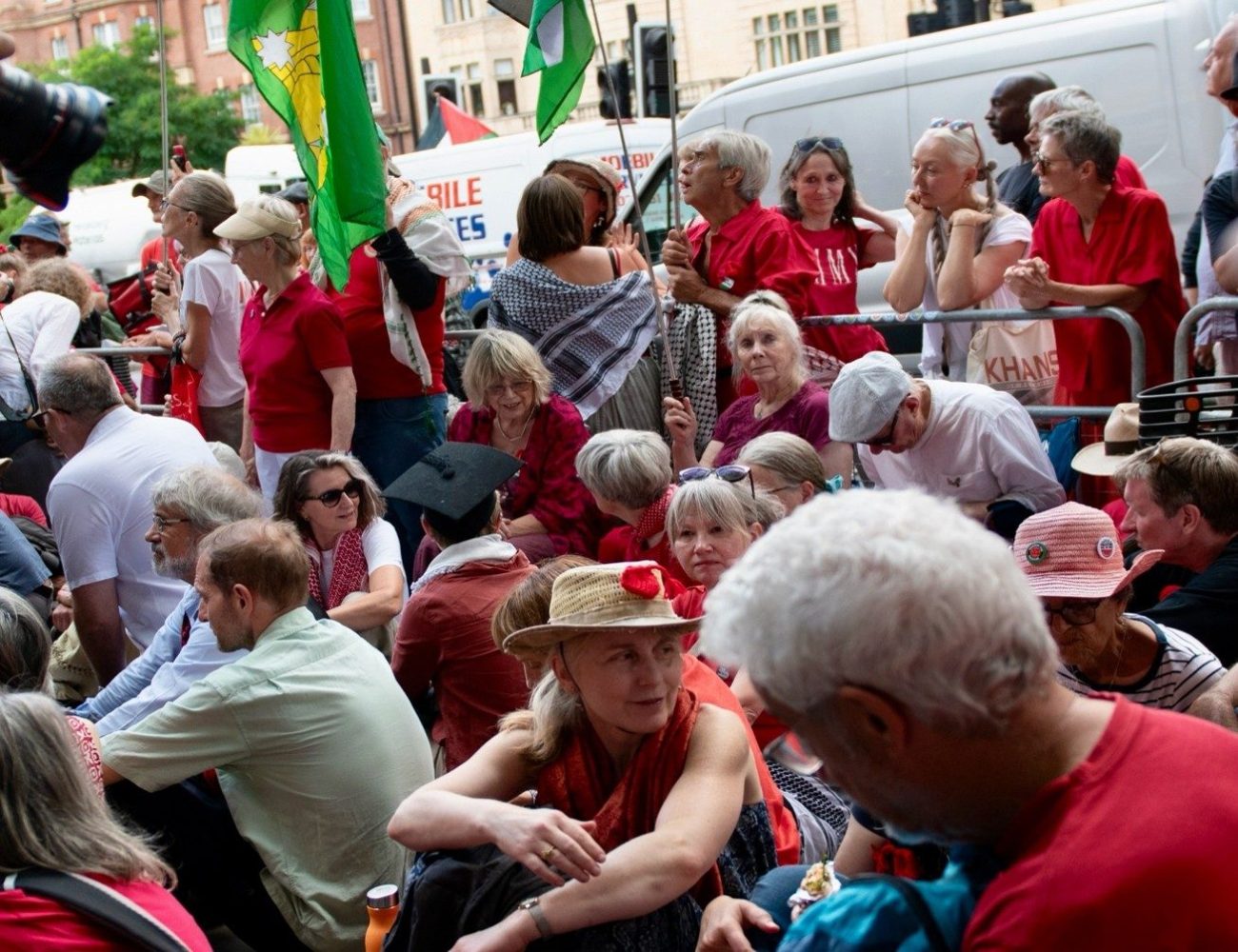
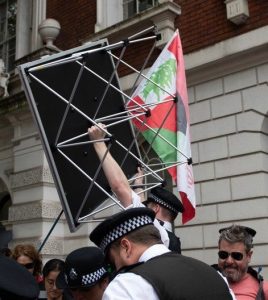
The action was to start at 12 noon with some speeches and poetry spoken from a small stage with a microphone. Arrests were to happen in an orderly way from 1 pm with people queuing to take the stage. My train was delayed and I arrived at about 12.15 by which time the police had already removed any semblance of order, took away the stage and the microphone and started to arrest people they saw as organisers. It was the beginning of a few hours of chaos.
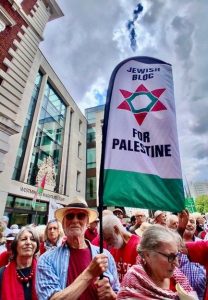
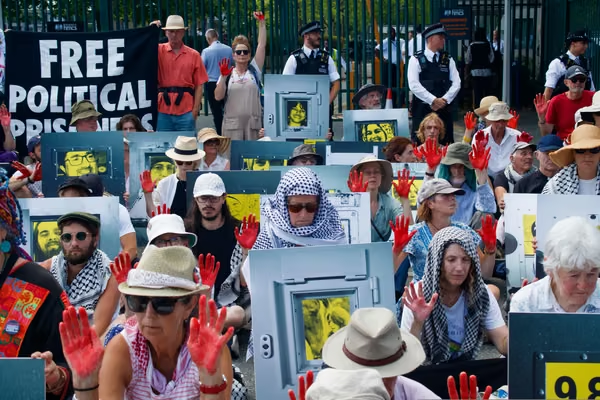
From 1pm we arranged that those planning to speak forbidden words would sit down in a group. I was passed the Jewish Bloc banner to take into the centre of the action where I sat
It seemed that the tension of the occasion, the seriousness of the allegations, and the police disruption created an air of anxiety, even shock among those waiting to be arrested. I had warm friendly conversations with those around me, but it seemed we all felt the tension. Our holding placards at other actions, had made it easy for arresting police to identify an alleged offence and its perpetrator.
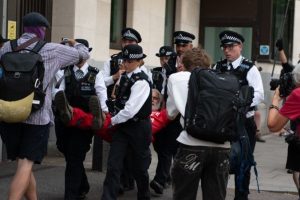
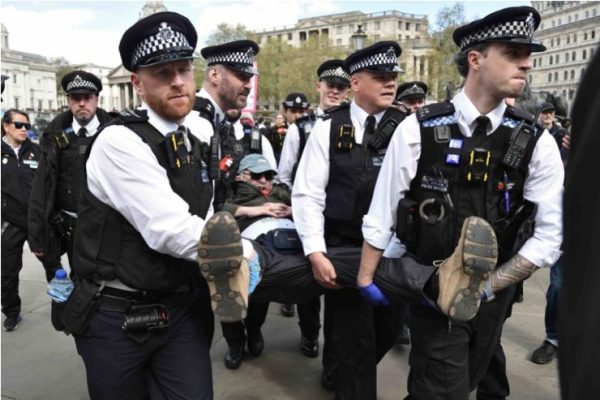
Spoken misdeeds cropping up haphazardly amongst the large, seated crowd, made the process of arrests less straight forward. The police set up a group of spotters to photograph and point out miscreants to other arresting officers who would take arrestees to waiting police vans. This introduced potential for mistaken identity and some humour as people looked to utter their phrases before being carted off. A few people popped up from a seated position and spoke their memorised formula, seemingly fearful of forgetting it, several times before arrest, sometimes adding an exasperated “I still” to “support Palestine Action.”
A decision to maximise arrests
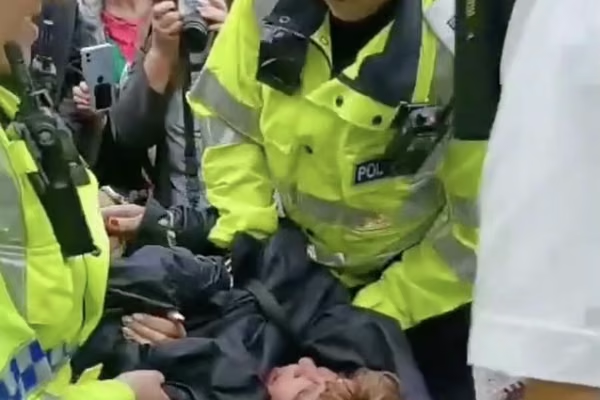
The keenness of police to arrest people and even add extra charges belied their later claim to be concerned about diverting police resources. I had been sitting and standing next to a friend for some hours before he judged the moment right, to speak his words. The arresting police group accused him not only of breaching Sections 11 and 12 of the Terrorism Act but of “assaulting an emergency worker, a police officer”. I knew this was untrue. Others remonstrated that he was a committed pacifist. He was horrified by the thought that he would be accused of being violent to anyone. Earlier I had noticed a policeman tripping over the leg of someone sitting nearby and accusing him of trying to trip him up – so it may have been mistaken identity. It may also have been maliciousness by the police towards a person of colour. The arrest was filmed, and there were several other witnesses. It seems absurd to think that his charges may continue until a court hearing.
Two other friends were arrested who had come only to lend moral support to others and with the deliberate intention not to be arrested themselves. One, a woman in her seventies had just sat down on her stool:
“Not long after I sat down a very young policeman came to my side and bent down and asked: “why are you sitting down”. I said: “because my legs are aching and my back is starting to ache too”.”
He immediately spoke his little spiel: “I’m now arresting you under section 12 of the Terrorism Act 2002 and whatever you say…” He said I had joined in with a group who were chanting illegal words. I was furious, saying: “That is wrong, you’ve got it completely wrong. This is just rubbish.”
She had not brought her phone recognising that the police could act unpredictably. The other friend had arranged to meet her daughter after the action and had brought her phone showing that she intended not to be arrested. She was accused of chanting illegal words, and it was claimed this had been captured on film. She knew this was untrue and said she was “fucking” angry. Both friends were taken eventually to Hounslow police station and detained in a police cell for three hours.
My own arrest
Because I had watched the chaotic experience of others, I wanted to make sure that the police were watching me and filming my little speech. By this time there were not many of us left and there was less chance of misidentification. I said my chosen piece as loudly and with as much drama as I could manage, in case it was picked up by social media:
“Jews of my age grew up in the shadow of the holocaust. I never imagined that I would still be living under its shadow today . I oppose genocide. I support Palestine Action. I urge others to do the same. Opposing genocide is not terrorism.”
A young policeman led the small group arresting me and carrying me to a side road, where I sat on the pavement until there was space available in a police van. I was taken with a couple of others, the short, slow, traffic impeded, journey to Charing Cross police station. My arresting officer wanted to reassure me that he thought we would only be detained briefly. He handed me my water bottle when I asked for it, unlike others who had refused me a drink in the past. I pointed out that my metal bottle was a lethal weapon, just like my metal framed seat, and was therefore proof that he did not consider me to be a terrorist or have terrorist leanings. I hoped that his body worn camera was working and that this exchange could be presented in court if necessary. When we joined a queue for a couple of hours in the police station yard, he suggested that I sit on my chair and read a book.
Inside the police station, I was photographed and fingerprinted and then left in a police cell with a vegan curry and cups of water and my book for several more hours. I had unsuccessfully argued to keep hold of my Kindle. I was released in time to get home to Cambridge that night. A few of us were being shepherded out of the station by a policewoman who apologised for the delay in our release because of a bureaucratic error as shifts changed. We were given simple bail conditions not to take part in any protest in support of Palestine Actions and told to report at Plumstead Police Station in October.
During the day it had been announced that the Supreme Court was willing to hear an appeal against the judgement from the Court of Appeal. I hope that before then, the new Labour administration, will have acted. If that does not happen there is a chance that a sensible decision of the Supreme Court, will end the proscription, cancel further proceedings and release all those imprisoned because of the ban, and that this will lead on to a change for the better to the draconian anti-protest legislation in the UK.
Who wasted police time?
By the end of the day, 152 peaceful protesters against genocide and for the right to freedom of expression, had been arrested. The Met Police issued a statement blaming us for diverting police resources from serious crime:
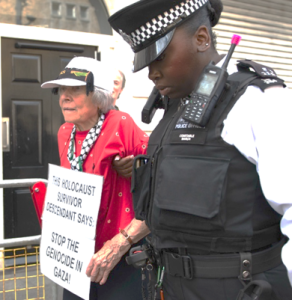
“While these individuals were deliberately getting themselves arrested, officers across London have dealt with almost 6,000 calls – including to high-risk missing children, serious sexual assaults and violent attacks.”
Essentially, this is an admission that the police had no “reasonable suspicion” that we in any way supported terrorism. They could have decided not to arrest us as Defend Our Juries made clear in its response to the police statement:
“It is a political choice for the Met to squander vast public resources on arresting peaceful protestors as terrorists…for putting up a small speaking platform or for trying to read poems from Gaza. The police always have a choice…The International Criminal Court Act, section 52, which is British law …makes it a crime to aid and abet genocide, war crimes or crimes against humanity…”
I saw what I had done as a day’s voluntary work; adding my small contribution to a bigger push to resist the suppression of protest against genocide in Palestine.
Thank you Tony. Admirable as ever.
Thank you and Solidarity✊🏼💚❤️🤍🖤