
Anti-Zionism confirmed as a protected belief
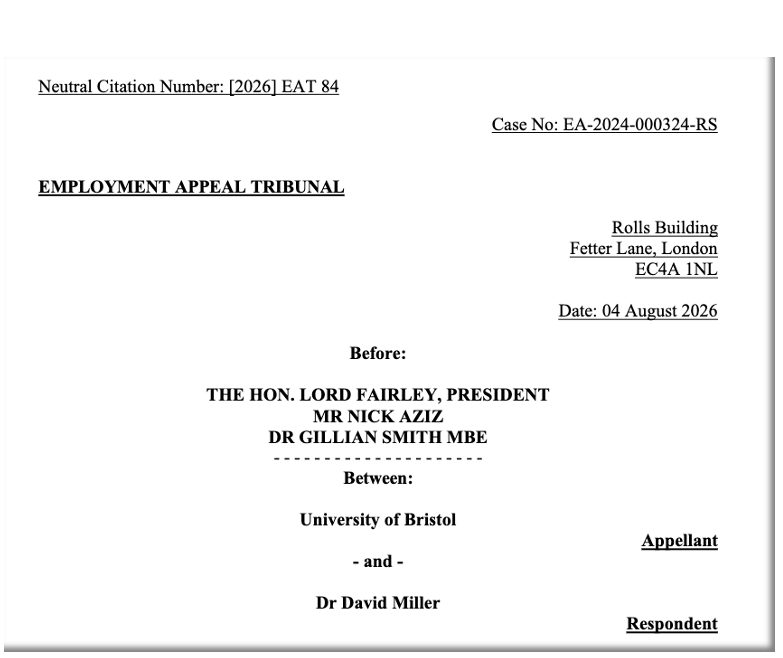
The Employment Appeal Tribunal’s decision in the case of University of Bristol versus Dr David Miller, published on 4th August, is a landmark ruling for free speech on Israel and Zionism. We will describe the sequence of legal actions that led to this result. It is the outcome that matters, which is that Anti-Zionism is now a protected belief in law, joining other protected non-religious views such as humanism, environmentalism and gender-critical views.
Lord Fairley, President of the Employment Appeals Tribunal included these words in his judgement on the case:
“It is coherent to describe as “racist” an ideology that promotes the establishment of a state for only one race of people in a territory that contains a large number of people of a different race. Such an ideology, which supports the migration of members of the first group into the territory with the support of an imperial power to dislodge an indigenous population, could also coherently be described as colonial and imperialistic.”
The ruling means that the expression of anti-Zionist beliefs is now protected in the workplace. Employers will need to be more cautious about pursuing cases based on often spurious allegations of antisemitism. It therefore provides a protection against harassment from which many campaigners against Israeli apartheid, settler colonialism and genocide should now benefit.
Too often employers, sometimes under pressure from pro-Israel campaigns, have taken punitive action on the basis that any anti-Zionist statement is, de facto, antisemitic. In future they will have to prove an antisemitic intent. The result is that the ability of anti-Zionists to make principled criticism of Israeli actions is now greatly enhanced.
Here is the legal history. David Miller was dismissed from his post as a Professor at Bristol University in October 2021. He took his dismissal to an Employment Tribunal held in late 2023 – and won. But Bristol University appealed that decision, and it is that case, heard by the Employment Appeal Tribunal, that has now concluded, not just with the rejection of Bristol’s appeal but also with a towering judgement that has wide implications.
The rejection of the University’s appeal doesn’t only mean that they have to pay him damages for loss of employment: a crucial outcome of this decision is that, unlike the initial decision by the Employment Tribunal, the victory at an Employment Appeal Tribunal sets a legal precedent.
The important principle behind Miller’s case, which was explicitly and emphatically confirmed by the appeal tribunal, is this: Dr Miller had been discriminated against because of his anti-Zionist beliefs, and his anti-Zionism has been recognised as a ‘philosophical belief’ under the Equality Act 2010.
Why on earth did Bristol University persist in pursuing its determination to get rid of Miller despite the advice, twice, from its own legal advisor that there were no grounds for dismissal? Why next insist on appealing the Employment Tribunal’s clear finding against it – an appeal against which it has just lost comprehensively?
Miller’s initial dismissal took place after a ‘pile on’ from right-wing newspapers, Labour’s then Mayor of Bristol, more than 100 MPs and Lords and the Government’s advisor on antisemitism. The establishment clearly wanted blood, and the university, shamefully, tried to deliver it – in a betrayal of academic freedom and free speech.
This campaign has now received its deserved comeuppance. JVL, along with all UK campaigners for Palestine, owe David Miller a major debt of gratitude for his steadfastness in pursuing this case to victory. It is a victory for the whole Palestine support community and in particular for those who have an explicitly anti-Zionist politics.
While we celebrate a notable legal victory, we remain highly critical of many public statements made by David Miller since his sacking by Bristol University. Some of these attribute a very broad and malevolent influence to Jewish power, which we reject out of hand as unfounded and conspiratorial. JVL published a statement on Miller’s postings and also a fuller analysis in 2025.
Throughout we have, though, never wavered from our view that his dismissal was unjust, born of prejudice, and procedurally flawed. We have consistently defended him from the baseless criticisms aimed at him and the assault on his academic freedom. We saw and see these as also having a broader aim of suppressing advocacy for Palestine both on campus and more widely. We celebrate the defeat of this campaign and the now established right to oppose Zionism free of any implication of having an ulterior racist motive.







“Miller’s initial dismissal took place after a ‘pile on’ from right-wing newspapers, Labour’s then Mayor of Bristol, more than 100 MPs and Lords and the Government’s advisor on antisemitism. The establishment clearly wanted blood, and the university, shamefully, tried to deliver it – in a betrayal of academic freedom and free speech.”
Are you – as I am – reminded of the parallels between this case and the “contempt of court” shenanigans mounted against Raji Menon KC arising from his impressive defence of one of the “Filton 6”?
I’m pleased the hearing of the Menon case has been “unexpectedly” delayed until October. I live in hopes the Burnham government will dismantle the shameful attacks on fair trials and support for Palestine (the hallmarks of Starmerism, in my view).
I agree fully with the above. As someone who has disagreed vehemently with some of David Miller’s subsequent statements, I nonetheless fully concur with the view that this is an extremely important victory in giving protection to those who face dismissal or disciplinary action because of their anti-Zionist views.
Just a word of caution. Bristol University may appeal to what is a highly reactionary Court of Appeal.
Does this mean anything for NHS staff who have been suspended from employment for the same pervasive reasons??
The current government initiative of the use of the IHRA in the NHS against pro Palestine expression should now receive a distinct blow. Likewise the ruling on fighting antisemitism in the education profession where a similar line of condemnation of pro Palestine is being implemented. At the moment there are several high profile legal persecution cases taking place such as that of Dr Brar from Kings College Hospital and lesser known ones in the case of an NEU teacher in North London. This exoneration of David Miller is of real significance in the resistance of the Palestinian movement to demonisation mainly in the form of accusations of antisemitism, the most used trope from Israel and also the accusation of terrorism used by the government to punish Palestine Action supporters for damage to weapons manufacturers factories.
I disagree on several count. This is no victory for critics of Israel. If anti-zionism is a a protected belief then so too must be zionism, though no-one seems ft to have made that observation. Further, protected beliefs are in their nature (as the original tribunal acknowledged) not susceptible to evidence and argument. So this case cannot also be one of academic freedom as Miller himself initially argued, claiming it was his area of expertise. It can’t be both. What kind of victory is that?
I don’t think Richard Kuper has read the original judgement very carefully. It does say Miller was unlawfully dismissed, largely on procedural grounds. It did not recommend he should be reinstated. It recommended that any compensation be reduced because his behaviour had contributed to his dismissal. It added that he could fairly have been dismissed very shortly afterwards for his subsequent remarks about the overrepresentation of Jews in positions of power. His recent outpourings about Pax Judaica are indisputably antisemitic.
As Ruth says, the Employment Tribunal decision recommended that any compensation be reduced because his behaviour had contributed to his dismissal. Certainly his persistent attacks on Jewish societies — as instruments of the Zionist lobby — contributed to the false allegations against him and thus his 2021 dismissal. In its decision, however, the University was not so stupid or reckless as to accuse David Miller of antisemitism. Rather, it said, he “did not meet the [university’s] standards of behaviour”. His legal team had to demonstrate to the Tribunal that this was a pretext, as well as to demonstrate that the real reason (his AZ beliefs) should be a protected characteristic. Employers will continue to deploy pretexts, and Employment Tribunal cases will need to demonstrate this role. So, beware!
Ruth also says, ‘If anti-zionism is a protected belief, then so too must be zionism.’ Let’s start with the legal concept, namely: Under the Equality Act, an employer cannot legally discriminate against an employee on grounds of a protected characteristic; this term refers to a list which has been expanding through test cases. Every criterion on the list corresponds to real cases of employer discrimination. Question: Has any UK employer discriminated against an employee on grounds of their Zionist beliefs? Has any UK employer been accused of such in legal proceedings? If not, then why not? The answer should be obvious, namely: The UK’s entire political-economic system has a century-long commitment to the Zionist project. Zionist beliefs have always been a protected characteristic in practice, since long before the Equality Act.
Hi Ruth
I think “zionism” hasn’t ever been cited in the UK as grounds for workplace disciplinary actions or legally acceptable reasons not to recruit someone. “Anti-zionism” has. That’s why this victory is so important.
Now that “anti-zionism” has been declared by the Employment Appeal Tribunal to be a protected belief, SERVICE PROVIDERS (eg offering rooms for hire) should also be bound under the 2010 Equality Act not to illegally discriminate against educators and audiences with those opinions.
Though largely supportive, the EAT did ask the first Tribunal to revisit various of its arguments and disagreed with others it put forward. The EAT was scathing about the University of Bristol’s cases as put forward at the first and second Tribunals.
Ruth Levitas claims above that “If anti-zionism is a a protected belief then so too must be zionism, though no-one seems ft to have made that observation.”
If that observation has not been made it is probably because the reasoning is false.
In order for a philosophical belief A to have legally protected status in employment law it must satisfy the Grainger test, which requires that it possess:
“ …a certain level of cogency, seriousness, cohesion and importance;
must be worthy of respect in a democratic society; be not incompatible with human dignity and not conflict with the fundamental rights of others.”
Hence it does not follow that if A is a protected philosophical belief, an ‘opposite’ philosophical belief is also a protected philosophical belief – because it may well fail the Grainger test.
Ruth also claims that “protected beliefs are in their nature …. not susceptible to evidence and argument. So this case cannot also be one of academic freedom”
However §138(iii) of the EAT judgment specifically denies
“the proposition that a belief that is informed, to any extent, by scientific or
empirical research will necessarily fall outside the scope of protection”, citing legal precedent.
As Richard correctly claims this is undoubtedly a very significant legal victory, especially in discrediting the conflation of antisemitism with
anti-zionism in the context of employment law. However there are important caveats to the tribunal judgments which should not be overlooked:
The judgments do NOT claim that Miller’s beliefs are correct – only that they are coherent. So the EAT judgment only establishes that Miller’s specific beliefs about what zionism is, as accepted by the tribunal, are coherent and satisfy the Grainger test. Since there exists no statutory definition of ‘zionism’, this judgment does not necessarily carry weight in any case where someone expresses a belief about zionism which attributes a different meaning to the word from that of Miller. In particular Miller states that his use of the word refers specifically to political zionism.
Ruth Levitas:
“This is no victory for critics of Israel. If anti-zionism is a a protected belief then so too must be zionism”………….Is this really true? Does it really follow? I don’t believe so: some believe the earth is flat. I see it as a victory and certainly a move forward which if acknowledged by good old UK law, will prevent anti-zionism being able to be equated with anti-semitism.