
Mayor’s Office shrugs off complaint about Met Police Nakba Day decisions
JVL Introduction
Natasha Ali-Goldberg read our article, Formal complaint made about Met chief over Nakba demonstration smears, and it encouraged her to make her own complaint. We reproduce here the response she received from MOPAC (Mayor’s Office for Policing and Crime).
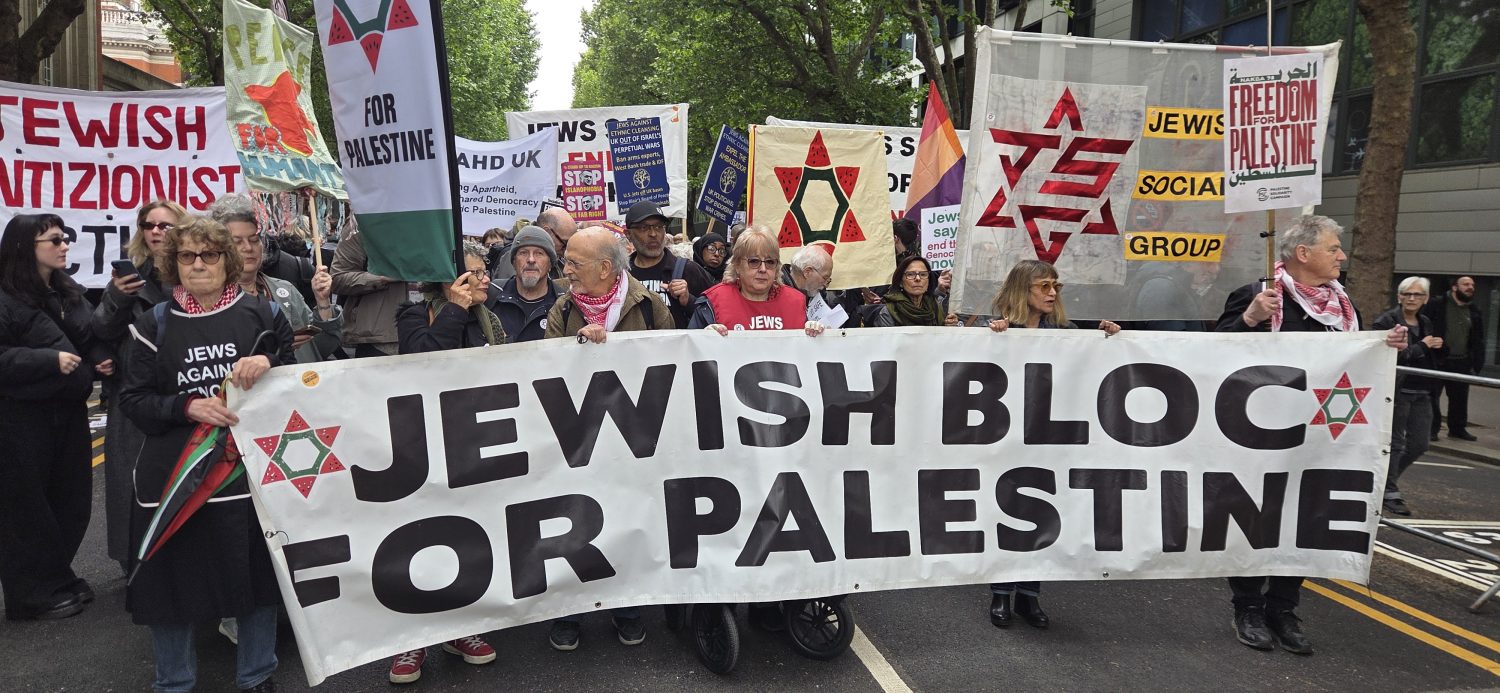
The reply accepts that the fear expressed by some London Jews is real, as do we, but goes further and expresses the strong belief that the fear is justified by the actions of people voicing their opposition to Israel’s genocide.
It is concerning that public authorities appear to act as though the right of people to oppose crimes against humanity is less important than the right of people who seem less troubled by these atrocities not to be disturbed. The better reaction by the Police and the Mayor would be to be vocal in their condemnation of the genocide and careful and patient in explaining that these protests do not threaten the safety of any Londoners. They should cease amplifying the voices of those who spread alarm by encouraging their communities to feel unnecessarily threatened. Perversely they are damaging the ability of those they claim to represent to enjoy their lives. There is no connection between the marches and the Golders Green stabbings.
Then we can collectively attempt to deal with the conditions which provoke real antisemitic outrages like that in Golders Green.
MC
I made a complaint to Mayor’s Office for Policing and Crime (MOPAC) about the issues raised in our article Formal complaint made about Met chief over Nakba demonstration smears and the reply was was follows –
Dear Natasha,
Re: Your complaint against the MPS Commissioner
Thank you for your complaint submission against the Metropolitan Police Service (MPS) Commissioner, Sir Mark Rowley.
I am sorry to hear your concerns about the MPS Commissioner’s comments in a written interview, published online in The Times, and made during a live interview on Good Morning Britain, broadcast on ITV 1, on 1st May 2026.
At the outset, I would like to apologise on behalf of the Mayor’s Office for Policing and Crime (MOPAC) for the delay in progressing your correspondence.
Your complaint raises concerns regarding the conduct of the MPS Commissioner. Specifically, you express dissatisfaction with statements made by the MPS Commissioner on 1st May 2026 concerning pro-Palestinian protests, including comments suggesting that organisers intended to route marches past synagogues and the inferences drawn from this, as reported in the media.
MOPAC is the Appropriate Authority for complaints against the MPS Commissioner and is responsible for assessing how to deal with such a complaint. In doing so, I have considered the Police complaint legislation, which specifies who can make a complaint, and states that the complainant must be a member of the public who:
(a) claims to be the person in relation to whom the conduct took place;
(b) claims to have been adversely affected by the conduct;
(c) claims to have witnessed the conduct; or
(d) is acting on behalf of someone who satisfies one of the above three categories above.
A person cannot be regarded as a complainant solely on the basis of claiming to be adversely affected where they have only seen or heard about the conduct, or its alleged effects, without experiencing a direct personal impact. While you have clearly expressed dissatisfaction regarding the MPS Commissioner’s conduct, I do not consider that you have been directly affected by the matters described. As such, you do not meet the eligibility criteria to raise a complaint. For these reasons, your complaint is not eligible to be treated as a formal complaint against the MPS Commissioner.
The MPS Commissioner’s statements of 1 May 2026 were made in the context of a serious incident in Golders Green on 29 April 2026, during which two men were stabbed (this was in addition to another man who had been stabbed by the same assailant to whom he was known earlier in the day). This occurred against a broader backdrop of a sustained campaign of arson attacks targeting Jewish Londoners in recent months, alongside a significant rise in hate crime, particularly antisemitism. These developments have heightened fear within Jewish communities. The MPS Commissioner has emphasised that MPS policing plans reflect this context, including the assertive use of police powers and the imposition of strict conditions on protests where necessary.
While I acknowledge your concerns regarding the MPS Commissioner’s views on the routing of protests, it is important to recognise that his comments followed sustained attacks on Jewish communities and an increase in the national terrorism threat level to “severe”, indicating that an attack is highly likely. In response to this evolving risk environment, the MPS has adopted a firmer and more explicit stance in addressing hate crime affecting all communities.
In addition, a statement published by the Metropolitan Police Service on the social media platform, X, on the 4 May 2026, clarified the Commissioner’s comments to make it clear that in his view, these actions “could send a message to Jewish communities which feels like antisemitism”. The clarification also acknowledged that this “may or may not be a fair inference, but the strength of feeling from those communities makes clear that for many, it is the message it sends”.
The MPS Commissioner has made clear that it is the duty of police officers to protect all communities, while remaining firmly committed to upholding the right to peaceful protest. He also expects officers to adopt a robust, proactive, and interventionist approach wherever any community experiences heightened fear or intimidation, or where hatred is being incited, including instances of both racial and religious hatred.
I hope you can appreciate the significant challenges faced by policing in balancing an intensified focus on public safety with the need to ensure that all decisions remain proportionate, appropriate, and grounded in operational necessity.
Thank you for bringing your concerns to our attention.
Yours sincerely,
MOPAC Professional Standards Team| Mayor’s Office for Policing And Crime
The Original Complaint
02/05/2026
Dear Mopac,
I would like to submit the following as a complaint, regarding the article/interview Police Commissioner – Mark Rowley recently felt the need to speak on.
I have found his statements to be extremely divisive, and it will create bias, thus fuelling divisions in all communities and play into the hands of fascists and racists.
There seems to be low level of fully understanding Palestine, Israel, and what the Nakba and Intifada. Equally you must understand the difference between Judaism and the modern ideology of Zionism. These are not mutual bedfellows and not every Jewish person believes in Zionism or Israel. Just like Christianity, Hinduism, Islam etc there are many scions from orthodox to non-conforming to extreme nationalist scions.
- I’d like to address ‘from the river to the sea, Palestine will be free’. Which some equate to the harming of Jews. But who is doing this equating? Some politicians that appear to have been funded by pro-Israel lobby groups. Or legacy media or take advice from pro-Israel groups about antisemitism?
How is it many pro-Palestine Jews are not offended by this line? Even so where is the evidence that a great number of the Jewish community have met harm by this line?
I respectfully refer you to – The Likud Party in 1977 stated ‘between the sea and Jordan there will only be Israeli sovereignty’ . Why is this line acceptable considering the ethnic cleansing of an indigenous group of people for over 80 years?
- Nakba is Arabic and its old translation is ‘to afflict’ or to cause distress’ in modern terms ‘the great catastrophe’. Following the UN partition of historical Palestine where the indigenous population were ethnically cleansed and displaced from the land.
- Intifada means ‘to shake’. In context to resist. The Intifada’s to date resulted in the huge numbers of indigenous Palestinians being killed by Israeli military and civilians. That is not to say Israelis were also not killed. But the greater numbers were with the indigenous Palestinians.
Esther Kaplan used that terminology under the chapter ‘globalize the intifada’ back in 2003.
Again you must supply the evidence to show Jews have been killed by protestors that have used this word.
Mr Rowley recently stated, ‘we are facing a building pandemic of antisemitism in society’. The biggest pandemic we face is the bare face lies told to the public to manipulate the agenda of the few and to cause division. We forget the pandemics of racism, homophobia, domestic violence etc.
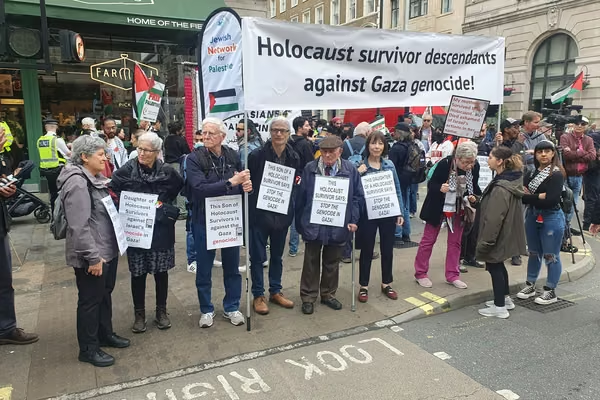
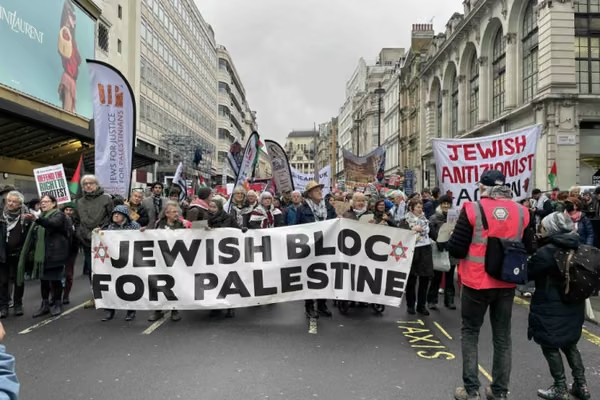
Why is it the Jewish communities at these pro-Palestine marches are not acknowledged by Mr Rowley? Are their voices not worthy?
A march is not a lethal weapon. Those who feel scared tend to be those that have an issue with other ethnic groups.
What is a hate march? What does it look like and what kind of people take part in these alleged hate marches? It is an absurdity to label a movement and define honest people has a perceived threat without evidence It looks like one side is trying to silence the other and that to me is chilling because ‘antisemitism’ is the weapon being used.
These marches are a myriad of differing people, ages, races, religion, LGBQT and they come together in a common community goal. One group of people cannot think their existence is at the beneficial killing of another group. That is unacceptable.
It isn’t war that creates peace, that is an illusion. It’s the people that protests. Strangers with a common goal. That goal is equality, justice and peace for all.
Golders Green -some will wonder if this was a mental health issue rather than how quickly it was labelled ‘antisemitic’. The perpetrator had attacked someone prior who was not Jewish. So, what made this attack antisemitic? That word is being overused, and clear reasoning has flown out the window.
It is odd how easy these incidents are being labelled very quickly as ‘terrorism’.
When a mosque is set alight with people in, it is not terrorism.
The comments of Mr Rowley are binary thinking and causing division.
‘Antisemitism is more than just about Jews, it’s a threat to democracy, it’s a miner’s canary for the health of societies. But the flip side, frequently ignored, is also true – that hatred of non-Jews can be the engine for antisemitism, something that becomes invisible when we focus only on parsing what is said about Jews, let alone Israel. When people hate they crave simplicity and certainty, and binary good/bad thinking.
This is a human characteristic rooted in how we divide the world into who is “us” and who is “them.” People who combat hate are also human and seek the seductive illusion of simple answers to complicated problems. Now the seductively simple, and illogical, tool is to employ IHRA.’
Regards
Prof Natasha Ali-Goldberg
‘I also ask you to keep in mind that while most of the cases of harassment of Jewish students have targeted pro-Israel ones, anti-Zionist or pro-Palestinian Jewish students have also been harassed, either as part of harassment of pro-Palestinian activists in general, or specifically targeting them as Jews, in which they are seen as “kapos” or “traitors,” and sometimes treated like such.’ Kenneth Stern


So according to MOPAC, whatever rubbish that Rowley says or writes does not have a direct personal impact on anyone so no-one is regarded as a complainant. How’s that for a get-out tactic?
Totally one sided given the context. For example “In response to this evolving risk environment, the MPS has adopted a firmer and more explicit stance in addressing hate crime affecting all communities”. So why the easy ride given to the Far Right demonstration on the same day which openly vilified Muslims? Also the implication that the third man stabbed on 29 April was Jewish as its presented in the context of a rise in antisemitism. The hierarchy of racism clearly rules supreme in both the Met Police and the Mayor’s Office.
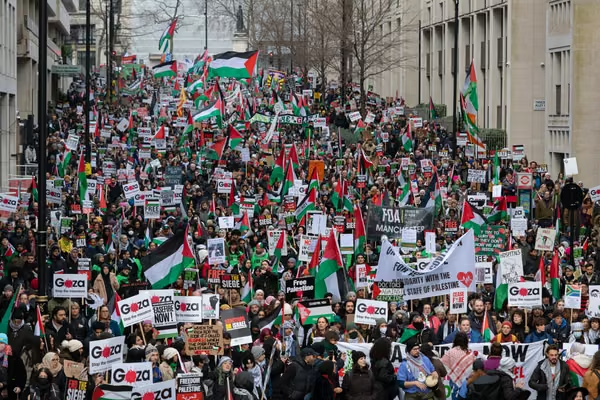
MC’s summation of the way the MET has laid down rules hits the nail on the head. The rules are bent rules which are biassed against whichever march the police choose to restrict/ban which are currently used to appease ‘those who feel uncomfortable’ or claim to be so affected. That there will be some genuinely affected by the appearance of large numbers of marchers in London is without much doubt but I believe fear engendered by pro-Palestinian marches is largely induced by baseless representation of them as ‘hate marches’ (Israeli sources and append ‘hate’ to many a thing eg ‘hate tunnels’ in Gaza), repeated verbatim by most of the MSM. The substantial Jewish bloc which takes part in these pro-Palestinian marches gives lie to the propaganda, but of course these are ‘self-hating Jews’ (another Israeli fantasy). That Israel is committing war crimes and much more throughout the Middle East is perfectly obvious, made more obvious by constant boasting of their vile ‘achievements’ and announcing to the world they will go further and further. Wrongly, Israeli treatment of the people of Gaza and the West Bank will cause hopefully only a few people to see Jewish people as one homogenous whole partially sharing the guilt, a belief given heft by the BoD’s portrayal of themselves as speaking for all UK Jews and that KS only speaks with them and never JVL.
I don’t know how this can be countered but I would hope that thinking Jewish people having seen the proof of the virtually peaceful marches in support of Palestine with their mix of people that their safety is not seriously at risk.
There is something deeply ironical about the police response to this attempt to make a complaint. Their view is that the writer has no right to complain as they were not affected by the actions complained of:
“A person cannot be regarded as a complainant solely on the basis of claiming to be adversely affected where they have only seen or heard about the conduct, or its alleged effects, without experiencing a direct personal impact. While you have clearly expressed dissatisfaction regarding the MPS Commissioner’s conduct, I do not consider that you have been directly affected by the matters described. As such, you do not meet the eligibility criteria to raise a complaint.”
Contrast this with the position of the people complaining about the pro-Palestinian protests. Few if any of them will have experienced any ‘direct personal impact’, adverse or otherwise, from the demonstrations and it unlikely that many will even have seen them. Nonetheless, their complaints are regarded not only as legitimate but as an adequate basis for denying important civil rights including freedom of speech and of assembly.
To summarise, the underlying principle seems to be that where something is disapproved of by the government virtually anyone is entitled to complain about it while if it is approved of virtually nobody is.
Thanks you, Rory O’Kelly,for this particularly astute and important comment. I’d put it alongside the (deliberately?) obfuscatory phrase that beings the IHRA definition: ‘Antisemitism is a certain *perception* of Jews..’. [my emphasis].